
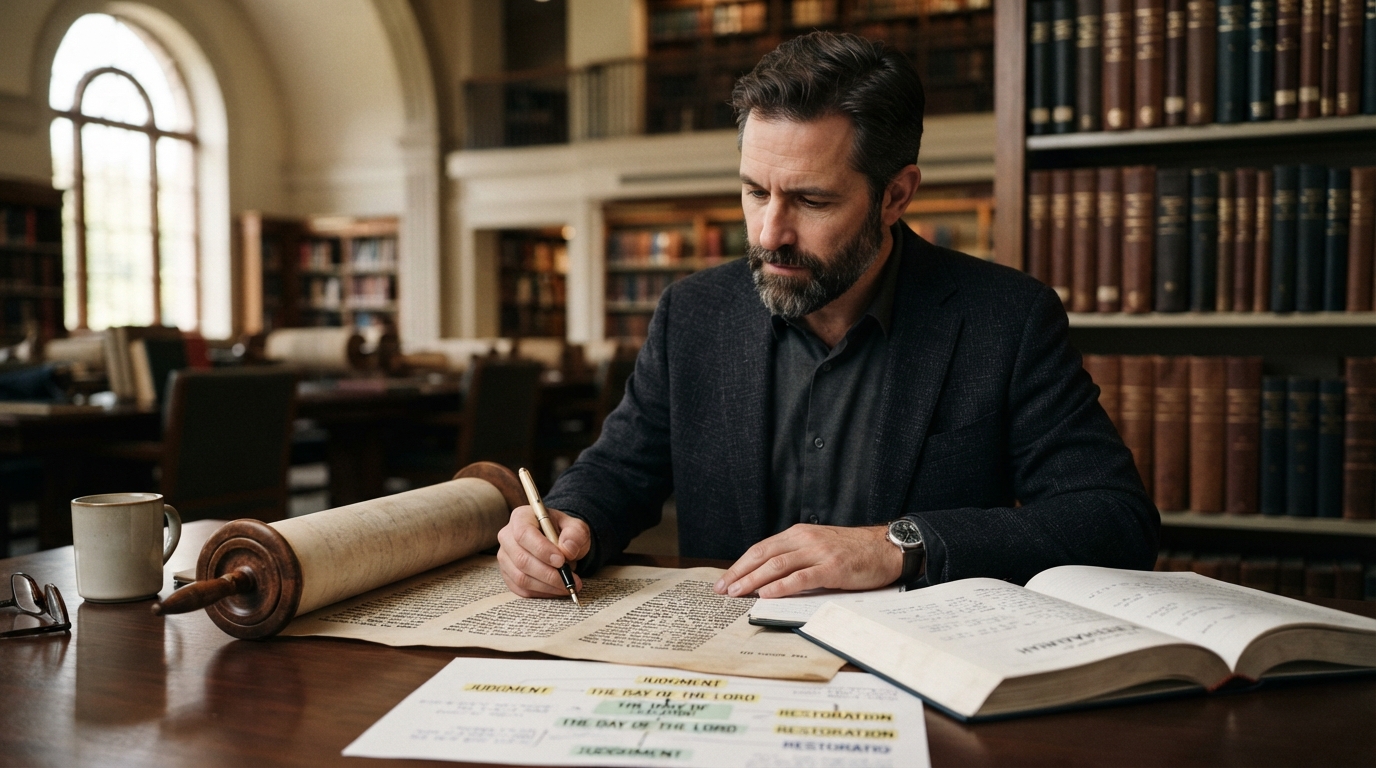
The literary style of the Book of Zephaniah is characterized by its **intense poetic urgency, highly structured concentric (chiastic) design, vivid cosmic de-creation imagery, and the masterful use of Hebrew parallelism**. As a prominent work among the Minor Prophets (the *Trei Asar*) of the Hebrew Bible, Zephaniah employs a dark, dramatic, and proto-apocalyptic tone to announce the impending “Day of the Lord” (Yom Yahweh), before pivoting sharply to an ecstatic, lyrical song of restoration and divine joy. This unique blend of sweeping universal judgment and intimate covenantal hope makes Zephaniah one of the most stylistically sophisticated books in Old Testament prophetic literature.To understand how this ancient text achieves its rhetorical power, we must examine its linguistic features, historical context during the reign of King Josiah, structural mechanics, and the specific literary devices the prophet used to shake Judah out of its spiritual complacency.
The Historical and Theological Context of Zephaniah’s Style
The literary style of any biblical prophet is deeply intertwined with their historical moment. Zephaniah operated in the mid-to-late seventh century BCE (around 640–609 BCE), during the early years of King Josiah’s reign in Judah. This was a time of immense geopolitical transition and internal religious corruption. Decades of syncretic religious practices under Kings Manasseh and Amon had left Judah spiritually fractured.Zephaniah’s language reflects this state of crisis. His style is not that of a detached academic, but of an urgent reformer. The imminent threat of the Scythian or Neo-Babylonian empires on the horizon provided a terrifying backdrop that Zephaniah translated into cosmic, universal terms. His theology of absolute divine sovereignty demands a literary style that is absolute, uncompromising, and sweeping in its scope.
Key Literary Features of the Book of Zephaniah
Zephaniah’s writing is highly sophisticated, utilizing a variety of classical Hebrew poetic forms and rhetorical strategies. Below, we break down the primary features that define his literary fingerprint.
1. Hebrew Parallelism and Poetic Rhythm
Like most of the prophetic books, Zephaniah is written primarily in poetry rather than prose. The foundational building block of Hebrew poetry is parallelism, where consecutive lines correspond to, expand upon, or contrast with one another. Zephaniah utilizes several types of parallelism:
- Synonymous Parallelism: Where the second line repeats the thought of the first in different words to reinforce the message.
Example: “I will utterly sweep away everything from the face of the earth, declares the Lord. I will sweep away man and beast…” (Zephaniah 1:2-3). - Antithetical Parallelism: Where the second line provides a contrast to the first, emphasizing two opposing realities. This is especially prominent when Zephaniah contrasts the proud with the humble.
- Synthetic (or Climactic) Parallelism: Where the second line builds upon and completes the thought of the first line, driving the emotional intensity forward.
2. Proto-Apocalyptic and Eschatological Tone
While full-blown apocalyptic literature (characterized by highly symbolic visions, angelic interpreters, and cosmic battles) developed later in Jewish history (e.g., Daniel, Zechariah), Zephaniah exhibits a “proto-apocalyptic” style. He uses hyperbole and cosmic language to describe historical judgments. The local destruction of Jerusalem is painted with the brush of a global, cosmic undoing of creation itself.
3. De-Creation Imagery (Reversing Genesis)
One of the most striking literary features of Zephaniah is his deliberate reversal of the creation account in Genesis 1. Where Genesis describes God systematically organizing, filling, and blessing the earth, Zephaniah describes a systematic “un-creating” or “sweeping away” of all things.
| Genesis Creation Order (Genesis 1) | Zephaniah De-Creation Order (Zephaniah 1:2-3) |
|---|---|
| Creation of humanity (man and woman) | “I will sweep away man…” |
| Creation of land beasts | “…and beast…” |
| Creation of birds of the air | “…I will sweep away the birds of the heavens…” |
| Creation of fish of the sea | “…and the fish of the sea.” |
This inverted literary structure serves a vital rhetorical purpose: it warns the audience that covenant disobedience does not merely result in political defeat; it threatens to plunge the ordered world back into primeval chaos (tohu va-bohu).
The Structural Design: Chiastic and Concentric Patterns
The Book of Zephaniah is not a collection of random, disjointed prophecies. It is a carefully curated literary unit. Scholars have noted that the book is structured as a massive chiasm—a symmetrical literary pattern where the themes of the first half are mirrored in reverse order in the second half, pointing toward a central focal point.This concentric structure can be mapped out to show how Zephaniah balances warning with hope:
- A: Universal Judgment Announced (1:2-3) — The de-creation of the cosmos.
- B: Judgment on Judah and Jerusalem (1:4–2:3) — Specific indictments against the ruling elite and religious syncretists.
- C: Judgment on the Surrounding Nations (2:4-15) — Oracles against Philistia, Moab, Ammon, Cush, and Assyria.
- B’: Indictment and Purification of Jerusalem (3:1-7) — A return to the sins of the holy city, but with a view toward cleansing.
- B: Judgment on Judah and Jerusalem (1:4–2:3) — Specific indictments against the ruling elite and religious syncretists.
- A’: Universal Restoration and Joy (3:8-20) — The gathering of the nations, the purification of speech, and the return of the remnant.
This structural symmetry is highly satisfying to the reader. It ensures that the terrifying weight of the book’s opening chapters is answered by the profound, comforting beauty of its conclusion. The structure itself conveys the theological message: judgment is not God’s final word; restoration is.
Key Themes and Their Literary Expression
Zephaniah uses specific literary techniques to highlight his core theological themes. Understanding these themes requires looking at the precise words and metaphors the prophet deploys.
The Day of the Lord (Yom Yahweh)
The central theme of Zephaniah is the “Day of the Lord.” While other prophets (like Amos and Joel) mention this day, Zephaniah provides its most detailed, terrifying, and poetic description in the entire Old Testament. He uses a literary technique called **accumulative description**, piling up synonymous terms to create an overwhelming sense of dread. In Zephaniah 1:15-16, he writes:
“A day of wrath is that day, a day of distress and anguish, a day of ruin and devastation, a day of darkness and gloom, a day of clouds and thick darkness, a day of trumpet blast and battle cry…”
This rhythmic accumulation of nouns and modifiers acts like a drumbeat of doom, building tension and leaving the listener with no room to escape the emotional weight of the impending judgment.
The Remnant of Israel (The Humble and Lowly)
In contrast to the proud, arrogant leaders of Jerusalem, Zephaniah introduces the literary motif of the “remnant” (she’erit). The linguistic markers used to describe this group are highly specific. They are called the “humble of the land” (anawim) who seek righteousness and humility. Zephaniah’s style shifts when speaking of this group; his language becomes tender, protective, and pastoral. The harsh, explosive consonants of the judgment oracles give way to softer, more comforting sibilants and vowels in Hebrew, reflecting the peace that awaits the survivors.For scholars, theologians, and writers analyzing these ancient stylistic shifts, partnering with a professional service like Collins Ghostwriting can help translate complex theological insights and literary structures into compelling, polished publications for modern audiences.
Vivid Metaphors and Anthropomorphisms in Zephaniah
Zephaniah is a master of figurative language. He uses metaphors that are both startling and culturally resonant to his ancient Near Eastern audience.
Searching Jerusalem with Lamps
In Zephaniah 1:12, God declares: “At that time I will search Jerusalem with lamps, and I will punish the men who are complacent, thickening on their dregs…”This is a brilliant double-metaphor:
- The Lamp Search: This anthropomorphism portrays God as a night watchman or a homeowner searching the darkest corners of a house with a small oil lamp. It communicates absolute divine scrutiny; no hidden sin, corrupt business practice, or secret idolatry will remain in the dark.
- Thickening on Dregs (Wine Metaphor): The phrase “thickening on their dregs” (or “settling on their lees”) refers to the process of wine-making. If wine is left to sit on its sediment (dregs) for too long without being poured from vessel to vessel, it becomes syrupy, harsh, and ruined. Zephaniah uses this to describe the spiritual stagnation and moral complacency of the wealthy elite who assume God will do nothing, either good or bad.
The Silent Presence and the Singing God
The book contains a fascinating stylistic contrast in how humanity and God interact in silence and sound:
- Human Silence before Judgment: “Be silent before the Lord God! For the day of the Lord is near…” (1:7). Here, silence represents terror, awe, and the realization of guilt.
- Divine Singing in Restoration: “He will exult over you with loud singing” (3:17). In a stunning anthropomorphic reversal, the transcendent, judging Creator of the universe is depicted as a joyful parent or lover singing loudly out of pure delight over His restored people. This is one of the few places in scripture where God is described as singing.
Analyzing Key Passages: Literary Examples
To appreciate the stylistic genius of Zephaniah, let us look closely at three key passages, analyzing their poetic structure, wordplay, and rhetorical impact.
Example 1: The Cosmic Sweep (Zephaniah 1:2-3)
“I will utterly sweep away everything from the face of the earth,” declares the Lord. “I will sweep away man and beast; I will sweep away the birds of the heavens and the fish of the sea, and the rubble with the wicked. I will cut off mankind from the face of the earth,” declares the Lord.
Literary Analysis: The passage opens with an intense Hebrew infinitive absolute construction (asoph aseph), which translates literally to “gathering I will gather” or “sweeping I will sweep.” This grammatical device emphasizes the absolute certainty and completeness of the action. The rapid listing of the elements of creation creates a cascading effect, mimicking the very sweep of destruction he is describing.
Example 2: The Military Alarm (Zephaniah 1:14-16)
The great day of the Lord is near, near and hastening fast; the sound of the day of the Lord is bitter; the mighty man cries aloud there. A day of wrath is that day… a day of trumpet blast and battle cry against the fortified cities and against the lofty battlements.
Literary Analysis: Here, Zephaniah uses short, staccato clauses to mimic the panic of a city under siege. The repetition of the word “day” (yom) acts as a relentless metronome of judgment. The contrast between the “mighty man” crying out in bitterness and the “fortified cities” falling down highlights the futility of human strength against divine decree.
Example 3: The Song of Transition (Zephaniah 3:14-17)
Sing aloud, O daughter of Zion; shout, O Israel! Rejoice and exult with all your heart, O daughter of Jerusalem! The Lord has taken away the judgments against you; he has cleared away your enemies. The King of Israel, the Lord, is in your midst; you shall never again fear evil.
Literary Analysis: The tone shifts dramatically from the dark, heavy, prose-like descriptions of judgment to a light, buoyant, lyrical rhythm. The prophet uses three synonymous imperatives in the first verse alone: “Sing,” “shout,” “rejoice/exult.” This triple call to praise mirrors the triple threat of judgment in chapter 1. The literary structure directly reflects the theological reality: the joy of restoration is just as complete as the devastation of judgment was.
Real-Time Search Queries and Academic Curiosities
Modern readers, students, and theologians searching for information on Zephaniah often look for specific stylistic and structural answers. Below are some of the most common real-time queries addressed through a literary lens.
Why is Zephaniah’s genealogy so long?
Unlike almost all other minor prophets, Zephaniah’s book begins with a four-generation genealogy: “The word of the Lord that came to Zephaniah the son of Cushi, son of Gedaliah, son of Amariah, son of Hezekiah…” (Zephaniah 1:1).
From a literary and historical perspective, this serves two purposes. First, it traces his lineage back to “Hezekiah,” who is widely believed to be the righteous King Hezekiah of Judah, establishing Zephaniah’s royal credentials and authority. Second, because his father’s name was “Cushi” (which can mean “Cushite” or “Ethiopian”), the extended genealogy proves his Judean heritage, ensuring his voice carried weight in the royal court of Josiah.
Is Zephaniah written in prose or poetry?
The Book of Zephaniah is written almost entirely in classical Hebrew poetry. While it contains brief prose introductions (such as 1:1), the actual prophetic oracles utilize poetic rhythm, parallelism, metaphor, and chiasm to maximize emotional and rhetorical impact on the listener.
What are the primary symbols used in Zephaniah?
The primary symbols include:
- The Lamp: Representing divine search, omniscience, and the exposure of hidden sins.
- The Wine Dregs: Representing spiritual complacency, stagnation, and moral decay.
- The Trumpet (Shofar): Representing alarm, warfare, the presence of God, and eschatological judgment.
- The Devouring Fire: Representing God’s consuming jealousy and holiness that purifies the earth.
The Literary Legacy of Zephaniah
Zephaniah’s literary style left a permanent mark on subsequent biblical and post-biblical literature. His vivid descriptions of the Day of the Lord heavily influenced the New Testament writers, particularly in the Book of Revelation, which similarly blends cosmic de-creation with ultimate restoration. Furthermore, the famous Latin hymn of the Middle Ages, the Dies Irae (“Day of Wrath”), is directly based on the Vulgate translation of Zephaniah 1:15. Through this hymn, Zephaniah’s poetic rhythm and terrifying imagery entered the Western musical and literary canon, inspiring masterpieces by composers like Mozart, Verdi, and Berlioz.By analyzing the literary style of Zephaniah, we discover a writer of immense skill who masterfully balanced structural symmetry, intense poetic rhythm, and striking metaphorical imagery to deliver a message that remains as stylistically compelling today as it was in the seventh century BCE.