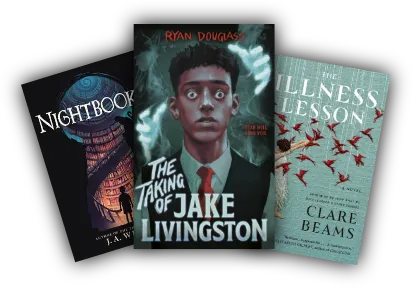
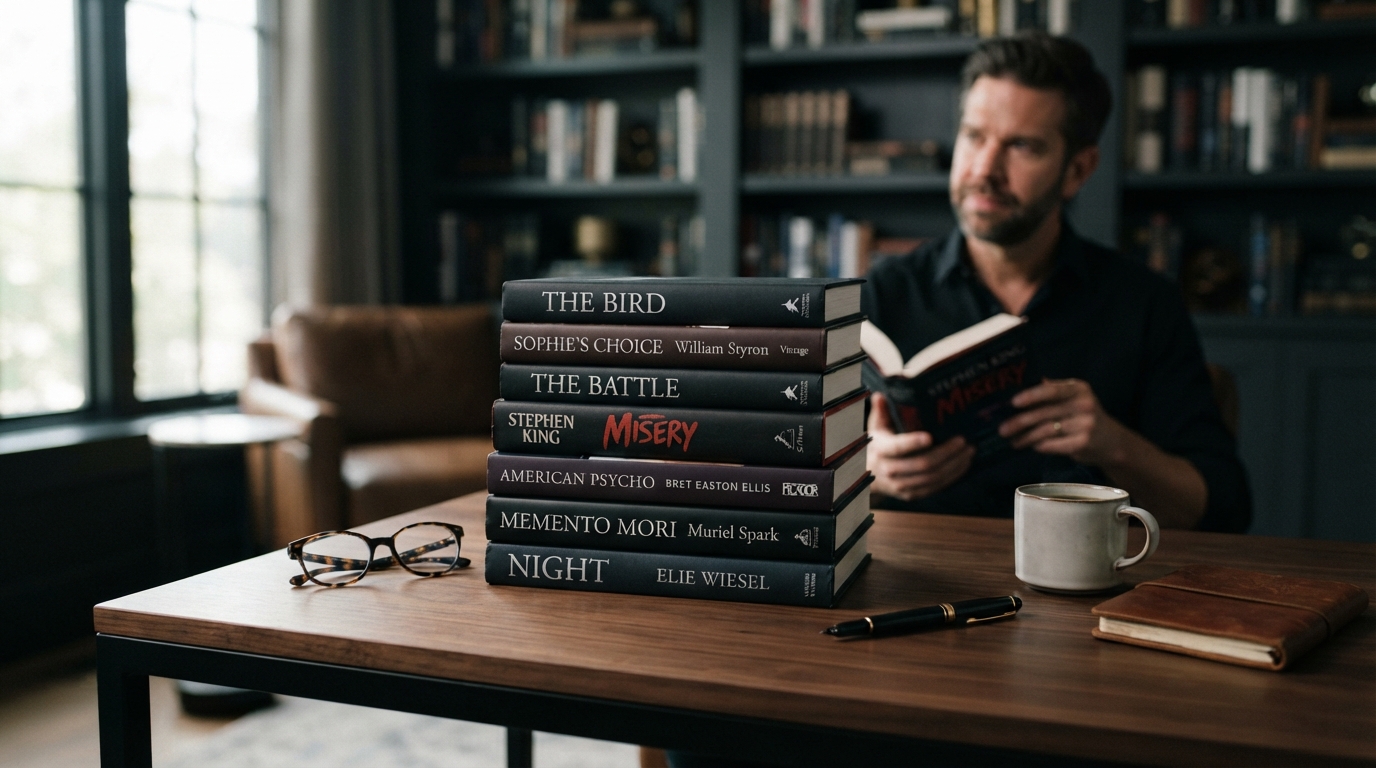
The Anthony Jeselnik Book Club refers to the informal yet celebrated reading list and literary recommendations curated by stand-up comedian Anthony Jeselnik, primarily broadcasted through his weekly podcast, The Jeselnik & Rosenthal Vanity Project (JRVP), alongside co-host Gregg Rosenthal. Renowned for his dark, hyper-precise stage persona and masterclass joke economy, Jeselnik is an avid scholar of highbrow literary fiction, transgressive literature, existential satire, and dark comedy. His definitive reading list features master prose stylists such as Denis Johnson, Joy Williams, Cormac McCarthy, Sam Lipsyte, and Ottessa Moshfegh. Readers exploring Jeselnik’s recommendations discover novels defined by uncompromising narrative voice, razor-sharp sentence structure, moral ambiguity, and biting humor.
The Anatomy of Anthony Jeselnik’s Literary Taste
To understand the Anthony Jeselnik book recommendations, one must understand the mechanic behind his stand-up comedy. On stage, Jeselnik delivers punchlines built on immaculate word choice, structural misdirection, and cold emotional detachment. This precise artistic sensibility stems directly from his background as an English Literature major at Tulane University, where he studied creative writing with an emphasis on short fiction and poetry.
Jeselnik does not gravitate toward light beach reads or standard plot-driven thrillers. Instead, his reading list favors prose-first authors—writers who treat every sentence as a load-bearing structure. His favorite works often explore uncomfortable human truths, moral failure, absurdity, and trauma, balanced by an acute sense of dark irony. Whether analyzing the bleak landscapes of Cormac McCarthy or the unhinged interior monologues of Sayaka Murata, Jeselnik looks for authors who refuse to apologize for their characters or soften their thematic blows.
For aspiring authors and literary enthusiasts looking to cultivate this level of narrative precision and voice, studying high-level literary craft is essential. Industry leaders like Collins Ghostwriting work closely with creators to distill complex, dark, or nuanced ideas into tight, impactful manuscripts that capture an unmistakable authorial signature.
Master Reading List: Anthony Jeselnik’s Top Recommended Books
The following dynamic chart catalogs the most prominent books recommended by Anthony Jeselnik across episodes of the JRVP Recommendation Station, literary podcasts, and media interviews. This curated table highlights the diversity of genres, key themes, and reasons behind his praise.
| Book Title | Author | Primary Genre | Core Literary Themes | Why Jeselnik Recommends It |
|---|---|---|---|---|
| Jesus’ Son | Denis Johnson | Short Fiction / Transgressive | Addiction, Redemption, American Gothic | Masterclass in sparse sentence economy and poetic vulnerability. |
| The Quick and the Dead | Joy Williams | Literary Fiction / Dark Satire | Ecological Decay, Existential Dread, Youth | Unmatched dialogue, sharp dark humor, and unpredictable prose style. |
| Blood Meridian | Cormac McCarthy | Historical / Epic Western | Violence, Destiny, Absolute Evil | Considered by Jeselnik as one of the greatest American achievements in literature. |
| Earthlings | Sayaka Murata | Japanese Fiction / Transgressive | Alienation, Conformity, Taboo | Shocking, hilarious, and completely uncompromising in its strange logic. |
| The Ask | Sam Lipsyte | Contemporary Satire | Middle-Age Disillusionment, Corporate Decay | Flawless comedic pacing and brilliant, cynical sentence-level writing. |
| Eileen | Ottessa Moshfegh | Psychological Thriller / Noir | Isolation, Obsession, Psychological Decay | Unsparing depiction of an unlikable protagonist crafted with poetic edge. |
| Harrow | Joy Williams | Post-Apocalyptic / Satire | Climate Catastrophe, Aging, Absurdism | Brutal comedic brilliance mixed with deep philosophical weight. |
| The Netanyahus | Joshua Cohen | Campus Novel / Historical Fiction | Identity, Academic Politics, Family Discord | Pulitzer-winning prose packed with intellectual speed and hilarious conflicts. |
| Sabrina & Corina | Kali Fajardo-Anstine | Short Story Collection | Indigenous Identity, Womanhood, Memory | Grounded, powerful storytelling with emotional resonance and crisp prose. |
| Train Dreams | Denis Johnson | Novella / Historical | Solitude, Industrialization, Loss | A compact masterpiece demonstrating how much power can fit in under 120 pages. |
Deep Dive: 10 Cornerstone Books Recommended by Anthony Jeselnik
1. Jesus’ Son by Denis Johnson
If there is a single book that serves as the foundation for Anthony Jeselnik’s reading philosophy, it is Denis Johnson’s iconic 1992 collection of interconnected short stories, Jesus’ Son. Set in the American Midwest among drug addicts, petty thieves, and lost souls, the book is narrated by an unnamed protagonist known only as “FH.”
Jeselnik frequently cites Johnson as his favorite writer of all time. What makes Jesus’ Son essential to the Jeselnik reading list is its radical prose economy. Johnson achieves staggering emotional resonance using minimal words, transforming squalor into beauty through hallucinatory lyricism. The famous opening line of the story “Car Crash While Hitchhiking” sets a tempo that every comedy writer and prose enthusiast strives to master.
2. The Quick and the Dead by Joy Williams
Joy Williams is arguably the living author Jeselnik champions most passionately on the JRVP Recommendation Station. The Quick and the Dead follows three teenage girls—Alice, Corvus, and Ann—navigating the scorching Arizona desert, personal grief, and the destruction of the natural world.
Williams’ writing matches Jeselnik’s comedic sensibility in its deadpan delivery and unexpected narrative turns. Her characters speak with an eerie, cerebral honesty that bypasses polite social convention. Jeselnik highlights Williams for her ability to weave devastating existential themes with sudden, laugh-out-loud dark satire.
3. Blood Meridian by Cormac McCarthy
Cormac McCarthy’s apocalyptic Western masterpiece, Blood Meridian; or, The Evening Redness in the West, stands as a monument in Jeselnik’s literary universe. Tracking the violent exploits of the Glanton gang along the Texas-Mexico border in the mid-19th century, the novel centers on “the kid” and the terrifying, philosophical antagonist Judge Holden.
Jeselnik praises McCarthy for his biblical, uncompromising prose style. There are no safe spaces in McCarthy’s work; the language is grand, terrifying, and rhythmically pristine. For readers interested in how dark themes can be elevated to high art, Blood Meridian remains required reading.
4. Earthlings by Sayaka Murata
Translated from Japanese by Ginny Tapley Takemori, Sayaka Murata’s Earthlings is one of the most polarizing and memorable picks featured on the podcast. The story follows Natsuki, a young woman who feels alien to societal expectations regarding career, marriage, and family, convincing herself that she is literally an extraterrestrial operational unit.
Jeselnik enthusiastically recommended Earthlings precisely because it dares to cross boundaries that standard contemporary fiction avoids. The novel transitions from quiet social satire into full-throttle transgressive horror, maintaining an eerie, innocent tone throughout. It represents Jeselnik’s affinity for fiction that shocks the reader while remaining artistically cohesive.
5. The Ask by Sam Lipsyte
Sam Lipsyte is widely regarded as one of the premier sentence stylists in modern comedic literature. In The Ask, protagonist Milo Burke is a failed painter turned mid-level university fundraiser who is tasked with soliciting a massive donation from a wealthy, eccentric former classmate.
Jeselnik points to Lipsyte as a primary example of how written prose can match the speed and biting efficiency of stand-up comedy. Lipsyte’s dialogue is packed with rhythmic insult comedy, social commentary, and pathetic human truth, making The Ask an ideal entry point for comedy writers looking to study craft.
6. Eileen by Ottessa Moshfegh
Ottessa Moshfegh’s breakout novel, Eileen, introduces a deeply lonely, misanthropic young woman working at a juvenile detention facility in 1960s New England. Trapped in a dreary home life with her alcoholic father, Eileen becomes fascinated by a glamorous new coworker, leading to a dark crime.
Jeselnik consistently recommends Moshfegh due to her mastery of unlikable, deeply flawed narrators. Rather than asking the reader to approve of Eileen, Moshfegh forces the reader into intimate proximity with her neuroses, grime, and secrets. The book exemplifies Jeselnik’s preference for fiction that prioritizes psychological authenticity over artificial charm.
7. The Netanyahus by Joshua Cohen
Subtitled An Account of Every Minor and Ultimately Even Negligible Episode in the History of a Very Famous Family, Joshua Cohen’s Pulitzer Prize-winning novel blends academic farce with serious debates on identity, Zionism, and assimilation.
Recommended during a JRVP episode, Jeselnik highlighted Cohen’s astonishing sentence speed and verbal ingenuity. The novel revolves around an American Jewish historian tasked with hosting an eccentric Israeli scholar and his unhinged family. The resulting chaos provides endless comedic momentum grounded in profound intellectual depth.
8. Sabrina & Corina by Kali Fajardo-Anstine
In this stark, moving collection of short stories set in Denver, Colorado, Kali Fajardo-Anstine examines the lives of Latina women of Indigenous ancestry navigating heritage, violence, friendship, and urban gentrification.
Jeselnik praised Sabrina & Corina for its clarity, character depth, and emotional precision. Unlike his inclination toward absurd or transgressive works, this recommendation demonstrates Jeselnik’s deep appreciation for classic, clean short fiction storytelling where every scene carries dramatic weight.
9. Harrow by Joy Williams
Returning to Joy Williams, Harrow is her first novel after a twenty-year hiatus. Set in a near-future world broken by ecological collapse, the story centers on Khristen, a teenager who wanders into a defunct resort filled with elderly eco-terrorists planning radical final acts.
Jeselnik called Harrow one of his favorite releases of its year, admiring Williams’ ability to combine apocalyptic sorrow with laugh-out-loud absurd dialogue. The book is dense, challenging, and filled with dark philosophical paradoxes that reflect Jeselnik’s personal aesthetic.
10. Train Dreams by Denis Johnson
A masterpiece of novella-length fiction, Train Dreams tells the life story of Robert Grainier, a day laborer in the American West during the early 20th century. Over a brief span of pages, Johnson captures the transformation of the American landscape alongside Grainier’s personal tragedies and quiet life.
Jeselnik frequently advises readers who want to enter Denis Johnson’s bibliography to begin here or with Jesus’ Son. Train Dreams displays absolute structural perfection—demonstrating how brevity amplifies emotional and narrative power.
The JRVP Recommendation Station: Categorized Book Breakdown
For listeners searching for specific reading moods, the Anthony Jeselnik reading list can be divided into focused categories. Below is a detailed breakdown categorized by literary genre and stylistic focus.
Transgressive & High-Intensity Fiction
- Earthlings by Sayaka Murata
- Convenience Store Woman by Sayaka Murata
- Homesick for Another World by Ottessa Moshfegh
- The Sluts by Dennis Cooper
- Fight Club by Chuck Palahniuk
Prose Perfectionists & Modern Stylists
- Jesus’ Son by Denis Johnson
- Train Dreams by Denis Johnson
- The Quick and the Dead by Joy Williams
- Blood Meridian by Cormac McCarthy
- White Noise by Don DeLillo
Biting Contemporary Satire & Dark Comedy
- The Ask by Sam Lipsyte
- Harrow by Joy Williams
- The Netanyahus by Joshua Cohen
- CivilWarLand in Bad Decline by George Saunders
- Sellout by Paul Beatty
Compelling Non-Fiction, Biographies & Memoirs
- Stay True by Hua Hsu
- Pops: A Life of Louis Armstrong by Terry Teachout
- Born Standing Up by Steve Martin
- Crying in H Mart by Michelle Zauner
- The Last Laugh by Mark Edmundson
How Anthony Jeselnik’s Reading List Influences His Comedy
There is an undeniable connection between literary craft and world-class stand-up comedy writing. Anthony Jeselnik’s stand-up specials—such as Thoughts and Prayers and Fire in the Maternity Ward—are constructed like collections of flash fiction or dark poetry. Every word is deliberate, unnecessary setup details are ruthlessly excised, and the punchline hinges on exact syntax.
“If you write jokes, you should read poetry and short stories. You learn where to put the word that makes the whole sentence detonate.” — Comedic Writing Principle
By immersing himself in authors like Cormac McCarthy, Denis Johnson, and Joy Williams, Jeselnik trains his brain in four crucial literary mechanics:
- Word Economy: Removing qualifiers, weak adjectives, and unnecessary prepositions to maximize impact.
- Subversion of Expectation: Using structural misdirection so the audience walks down one path before the sentence violently shifts.
- Tonal Commitment: Maintaining an unblinking, uncompromising voice regardless of how dark or taboo the subject matter becomes.
- Rhythmic Precision: Ensuring the cadence of the sentence creates natural tension and release.
Recommended Reading Pathways Based on Your Favorite Genres
If you are new to the Anthony Jeselnik Book Club, selecting the right starting point depends entirely on your reading preferences. Follow these targeted pathways to navigate his extensive recommendations efficiently.
Pathway A: The Dark Humor & Satire Track
Start with The Ask by Sam Lipsyte to experience fast-paced verbal wit. Move on to CivilWarLand in Bad Decline by George Saunders for absurd social commentary, and finish with Joy Williams’ The Quick and the Dead for high-art existential comedy.
Pathway B: The Literary Masterpiece Track
Begin with Denis Johnson’s Jesus’ Son to study perfect short fiction rhythm. Follow it with Train Dreams by Denis Johnson for lyrical beauty, and complete the pathway with Cormac McCarthy’s Blood Meridian for epic historical depth.
Pathway C: The Transgressive & Disturbing Track
Start with Ottessa Moshfegh’s short story collection Homesick for Another World. Progress to Sayaka Murata’s Earthlings for unhinged narrative escalations, and conclude with Dennis Cooper’s modern transgressive classics.
Popular Search Queries & Frequently Asked Questions
What books does Anthony Jeselnik recommend most on JRVP?
Anthony Jeselnik most frequently recommends highbrow literary fiction, dark short story collections, and transgressive novels. His absolute favorite authors, whom he mentions repeatedly, include Denis Johnson (Jesus’ Son), Joy Williams (The Quick and the Dead, Harrow), Cormac McCarthy (Blood Meridian), Sam Lipsyte (The Ask), and Ottessa Moshfegh (Eileen).
What is Anthony Jeselnik’s favorite book of all time?
Jeselnik has named Jesus’ Son by Denis Johnson as one of his absolute favorite literary works, citing its immense influence on his writing style, sentence structure, and appreciation for dark, vulnerable human stories.
Where can I find the full archive of JRVP Recommendation Station picks?
The complete archive of book recommendations can be found by listening to back episodes of The Jeselnik & Rosenthal Vanity Project (JRVP) podcast during the signature end-of-show segment called “Recommendation Station.” Dedicated fans also maintain updated spreadsheets and threads across Reddit and literary forums tracking every weekly pick.
Why does Anthony Jeselnik read such dark literature?
Jeselnik reads dark fiction because he values moral complexity, uncompromising artistic vision, and intense emotional stakes. He often states that light or predictable fiction fails to capture the true absurdity and difficulty of the human condition, whereas dark literary authors find profound beauty, humor, and truth in challenging topics.
Building Your Personal Library from the Jeselnik Reading List
The books endorsed by Anthony Jeselnik offer far more than simple entertainment. They serve as an informal masterclass in advanced prose styling, bold thematic exploration, and sentence-level craftsmanship. By exploring the works of Denis Johnson, Joy Williams, Cormac McCarthy, and Sayaka Murata, readers step outside predictable commercial tropes and enter a realm of brave, unforgettable literature.
To start your journey today, pick up Jesus’ Son or The Quick and the Dead. Observe the sentence rhythm, note how tension is constructed without extra fluff, and appreciate the dark, singular voices that have shaped one of modern comedy’s sharpest minds.