
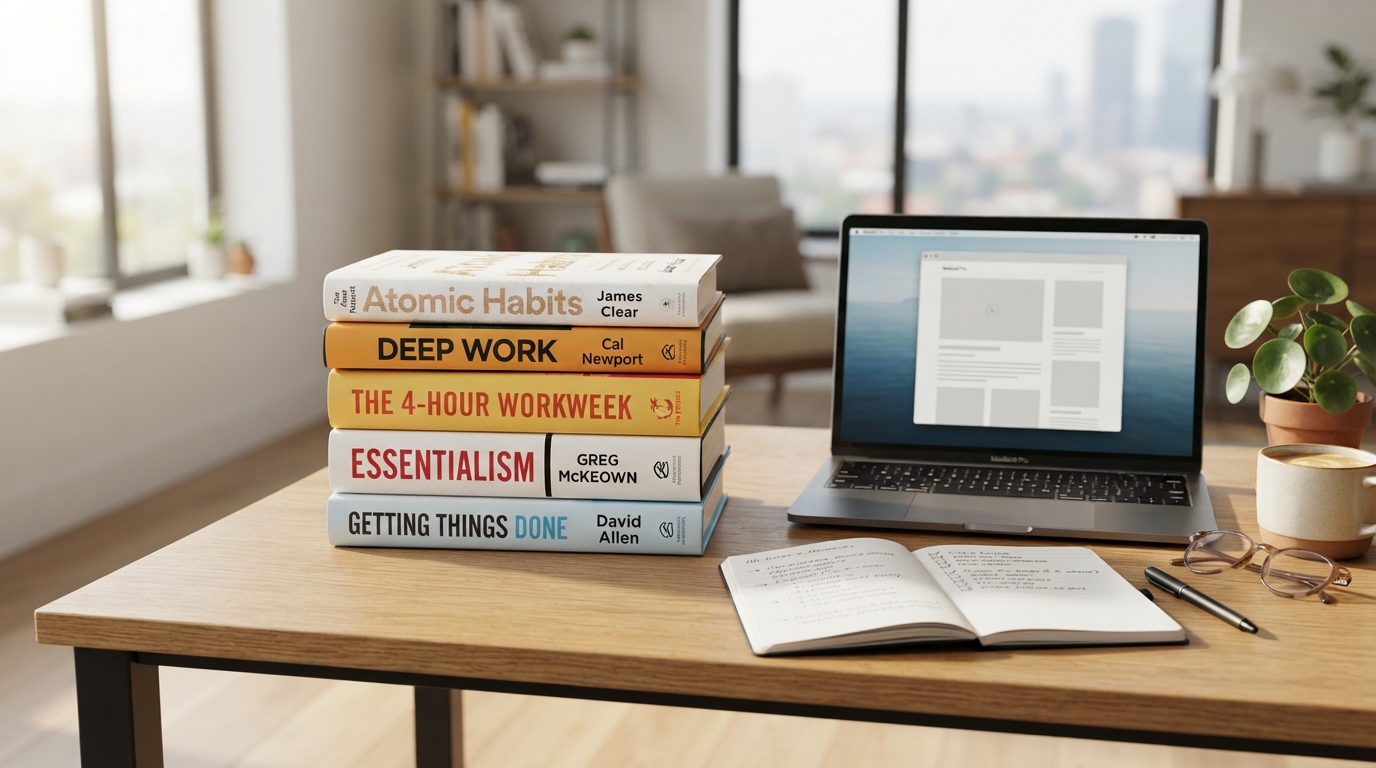
The best books for productivity that can transform your daily life are Atomic Habits by James Clear (for habit formation), Getting Things Done by David Allen (for workflow organization), and Deep Work by Cal Newport (for cognitive focus and minimizing distractions). These seminal texts shift your focus from frantic busyness to deliberate, high-impact output by addressing cognitive psychology, behavioral design, and structured time management systems. Implementing their frameworks can help you reclaim lost hours, reduce cognitive load, and achieve peak personal and professional performance.
In an era dominated by digital notifications, algorithmic distractions, and competing priorities, mastering personal productivity has become a survival skill. Whether you are an entrepreneur looking to scale your business, a creative aiming to master your craft, or a professional trying to escape the cycle of chronic procrastination, the right literature acts as a blueprint for cognitive engineering. If you have ever felt inspired to share your own frameworks for success but lack the time to write, partnering with professional Ghostwriting Services can help package your unique intellectual property into a market-ready manuscript.
Why Productivity Books Fail or Succeed: The Implementation Gap
Most readers fall into the trap of “productive procrastination”—the act of reading about self-improvement as a substitute for actually doing the work. This creates a temporary dopamine spike that mimics progress without yielding real-world results. To extract genuine value from the best productivity books, you must bridge the implementation gap using behavioral science principles.
According to cognitive psychology, memory retention and behavioral changes occur when information is actively processed and immediately applied. This is known as the testing effect or retrieval practice. When reading productivity literature, you should approach each book not as a passive narrative, but as an operating system upgrade for your brain.
| Aspect | Passive Consumption (Low Impact) | Active Implementation (High Impact) |
|---|---|---|
| Reading Goal | Finishing the book quickly to add to a reading list. | Extracting one actionable framework to test immediately. |
| Note-Taking | Highlighting passages that “feel” good. | Creating an actionable summary with a personalized checklist. |
| Behavioral Change | Relying on raw willpower to change habits. | Redesigning the physical environment to make habits frictionless. |
| Success Metric | Number of pages read per week. | Measurable reduction in daily administrative friction or stress. |
The Pillars of Productivity: Core Book Classifications
Productivity is not a monolithic concept. To build a highly functional life, you must optimize different areas of your cognitive and physical workflows. The most influential productivity literature can be divided into four distinct categories: Habit Formation, Systems & Workflows, Deep Focus, and Mindset Shifts.
1. Habit Formation & Behavioral Design
Habits are the compound interest of self-improvement. By automating repetitive decisions, your brain conserves precious mental energy for complex problem-solving. Understanding how to build positive habits and dismantle destructive ones is the foundation of all long-term productivity.
“Atomic Habits” by James Clear
James Clear’s masterpiece is arguably the most practical guide to behavior design ever written. Clear argues that you do not rise to the level of your goals; you fall to the level of your systems. By focusing on tiny, 1% daily improvements, you can achieve massive exponential growth over time.
- The Cue: Make it obvious. Design your environment so visual triggers prompt positive actions.
- The Craving: Make it attractive. Bundle habits you need to do with habits you want to do.
- The Response: Make it easy. Reduce friction and start with the “Two-Minute Rule” to build momentum.
- The Reward: Make it satisfying. Use immediate reinforcement to lock in the behavioral loop.
“Tiny Habits” by BJ Fogg, PhD
As the founder of the Behavior Design Lab at Stanford University, BJ Fogg provides a highly scientific yet accessible approach to habit change. His core formula, B = MAP (Behavior occurs when Motivation, Ability, and a Prompt converge at the same moment), shifts the focus away from willpower. Fogg teaches readers to anchor new habits to existing anchor events, such as flossing one tooth immediately after brushing.
2. Task Management & Workflow Systems
Without a reliable system to capture, organize, and prioritize your responsibilities, your brain remains in a constant state of low-level anxiety. This cognitive strain, known as the Zeigarnik Effect, occurs when uncompleted tasks clutter your working memory.
“Getting Things Done: The Art of Stress-Free Productivity” by David Allen
David Allen’s Getting Things Done (GTD) methodology is the gold standard for personal organization. The core premise is simple: your mind is for having ideas, not holding them. Allen introduces a five-step workflow to externalize your tasks and free up mental bandwidth.
- Capture: Collect everything that commands your attention into external trusted buckets.
- Clarify: Process what those inputs mean and determine if they require immediate action.
- Organize: Categorize actions into context-specific lists (e.g., @calls, @computer, @errands).
- Reflect: Conduct weekly reviews to update your systems and maintain operational clarity.
- Engage: Make trusted choices about what to do at any given moment based on context, time, and energy.
“The 12 Week Year” by Brian P. Moran and Michael Lennington
Many professionals struggle with annualized goals because the long timeframe creates a false sense of security, leading to procrastination. Moran and Lennington advocate for compressing your execution cycle from 12 months to 12 weeks. This structural shift creates a constant sense of urgency, driving rapid execution and frequent feedback loops.
3. Focus, Cognitive Performance & Deep Work
In a hyper-connected world, the ability to concentrate deeply on a cognitively demanding task is becoming increasingly rare. Those who can cultivate this skill will hold a massive competitive advantage in the modern knowledge economy.
“Deep Work: Rules for Focused Success in a Distracted World” by Cal Newport
Cal Newport defines deep work as professional activities performed in a state of distraction-free concentration that push your cognitive capabilities to their limit. These efforts create new value, improve your skill, and are hard to replicate. Newport contrasts this with shallow work: non-cognitively demanding, logistical-style tasks that are often performed while distracted.
“To produce at your peak level you need to work for extended periods with full concentration on a single task free from distraction. Put another way, the formula for high-quality work is: (Time Spent) x (Intensity of Focus).” — Cal Newport
Newport outlines four distinct depth philosophies to integrate deep work into your life: the Monastic approach (eliminating all shallow distractions), the Bimodal approach (splitting time between deep isolation and normal life), the Rhythmic approach (building a daily habit of deep work), and the Journalistic approach (fitting deep work into your schedule whenever free moments arise).
“Hyperfocus: How to Be More Productive in a World of Distraction” by Chris Bailey
Chris Bailey explores the limits of human attention, dividing focus into two modes: Hyperfocus (the ability to direct your attention toward a single object of focus) and Scatterfocus (a creative mode where your mind wanders and connects disparate ideas). Bailey provides actionable strategies to expand your attention span and manage your limited cognitive budget.
4. Essentialism & Mindset Shift
True productivity is not about getting more things done; it is about getting the right things done. It requires a fundamental shift from mindless execution to strategic elimination.
“Essentialism: The Disciplined Pursuit of Less” by Greg McKeown
Greg McKeown challenges the modern glorification of busyness. Essentialism is a systematic discipline for discerning what is absolutely essential, then eliminating everything else so we can make the highest possible contribution toward the things that really matter.
- Explore: Discern the vital few from the trivial many.
- Eliminate: Cut out the non-essential commitments that drain your energy.
- Execute: Build a system that makes execution frictionless and natural.
- The Power of “No”: Learn to say no gracefully and firmly to preserve your cognitive assets.
“The ONE Thing” by Gary Keller and Jay Papasan
Keller and Papasan ask a single, focusing question: “What is the ONE thing I can do such that by doing it everything else will be easier or unnecessary?” By identifying your lead domino, you can create a powerful cascade of success across your health, relationships, and business.
Comparative Analysis: Selecting the Right Productivity System
Every individual possesses a unique cognitive profile, lifestyle, and professional ecosystem. A system that works perfectly for a software engineer might fail catastrophically for a creative director. Use the table below to identify which methodology aligns with your specific operational challenges.
| Book Title | Core Concept | Best Suited For | Key Implementation Tool |
|---|---|---|---|
| Atomic Habits | Compound effect of 1% daily behavioral changes. | Anyone struggling with consistency or bad habits. | Habit Stacking & Habit Tracker. |
| Getting Things Done | Externalizing cognitive load into trusted systems. | Professionals overwhelmed by high volumes of tasks. | The Weekly Review Checklist. |
| Deep Work | Uninterrupted focus on cognitively demanding tasks. | Writers, developers, creatives, and strategists. | Time-Blocking & Distraction-Free Zones. |
| Essentialism | Disciplined elimination of non-essential tasks. | People-pleasers and over-committed professionals. | The Extreme Criteria for Decision Making. |
| The 12 Week Year | Compressing execution timelines to 12 weeks. | Entrepreneurs and goal-oriented high performers. | Weekly Scorecard & Execution Plan. |
A Step-by-Step Framework to Build Your Custom Productivity Stack
Do not try to implement every productivity framework simultaneously. This leads to system bloat and ultimate burnout. Instead, construct a personalized “Productivity Stack” by combining elements of different systems to fit your lifestyle.
Step 1: Build Your Daily Foundation (The Habit Layer)
Start with the behavioral mechanics outlined in Atomic Habits. Identify one foundational habit that will positively impact your entire day, such as waking up at 6:00 AM or planning your day the night before. Use habit stacking to anchor this new routine to an existing habit:
“After I pour my morning coffee (existing habit), I will write down my ONE thing for the day (new habit).”
Step 2: Externalize Your Mental Clutter (The Capture Layer)
Implement the capture phase of Getting Things Done. Create a single physical or digital inbox (such as Notion, Todoist, or a physical notebook) where you immediately write down every task, idea, or obligation that enters your mind. Never rely on your brain to remember a task.
Step 3: Establish Your Deep Work Ritual (The Focus Layer)
Identify a block of time each day for uninterrupted deep work. For most people, this is best scheduled early in the morning when willpower is high and external demands are low. Turn off all notifications, close non-essential browser tabs, and communicate your unavailability to others.
Step 4: Conduct a Weekly Review (The Calibration Layer)
At the end of every week, dedicate 30 to 60 minutes to clear your inbox, review your goals, and plan the upcoming week. This practice ensures your daily actions remain aligned with your long-term vision, preventing you from drifting into reactive busywork.
How Best-Selling Productivity Authors Structure Their Ideas
When you read books like Atomic Habits or Deep Work, you are observing masterclasses in intellectual property structure. These authors succeed not just because their ideas are novel, but because they present them with absolute clarity, engaging case studies, and highly actionable frameworks. They transform complex psychological research into consumable, life-changing content.
If you have spent years refining your own operational frameworks, business strategies, or life philosophies, you have valuable knowledge that could benefit others. However, writing a book requires a highly specialized skill set and hundreds of hours of focused writing. This is where professional collaboration becomes invaluable. Partnering with a premier service provider like Collins Ghostwriting allows you to co-create a compelling, authoritative book without sacrificing your daily operational focus. Their team of elite writers can capture your unique voice and translate your lived experience into a polished, market-ready manuscript that establishes you as a leading authority in your industry.
Frequently Asked Questions Regarding Productivity Literature
What is the absolute best productivity book for beginners?
For individuals new to self-improvement, Atomic Habits by James Clear is the recommended starting point. Its highly actionable advice, clear diagrams, and focus on small, manageable changes make it incredibly accessible and immediately applicable to daily life.
How do I stop reading self-help books and start taking action?
Implement the “Rule of One.” For every productivity book you read, select exactly one concept, framework, or habit to implement for at least 30 days before moving on to another book. If a book does not inspire immediate action, put it down and find one that does.
Can productivity books help with chronic ADHD or executive dysfunction?
Yes, but traditional systems can sometimes feel overwhelming. Books like Tiny Habits by BJ Fogg and Hyperfocus by Chris Bailey are highly beneficial because they focus on reducing friction, working with your brain’s natural dopamine pathways, and breaking tasks down into microscopic, non-threatening steps.
Is digital or physical note-taking better for retaining book insights?
Research suggests that writing notes by hand improves conceptual retention and synthesis. However, digital tools like Notion, Obsidian, or Roam Research are superior for long-term storage, searchability, and connecting disparate ideas. A hybrid approach—taking handwritten notes while reading, then synthesizing them digitally—often yields the best results.