Imagine spending months, or even years, pouring your soul into a manuscript, only to have a reader pull you out of your creative world because of a misplaced comma or a glaring subject-verb disagreement. This is the nightmare of every writer. When you reach the final stages of your writing journey, a critical question arises: Can a proofreader fix grammar mistakes?
Yes, a proofreader absolutely fixes grammar mistakes. In fact, correcting grammatical errors, spelling mistakes, punctuation inaccuracies, and typographical slips is the primary responsibility of a proofreader. They act as the final line of defense, ensuring your text is polished, professional, and mechanically flawless before publication. However, while they correct surface-level grammar issues, they do not rewrite paragraphs, alter your tone, or restructure your plot. For deeper structural changes, you would need to consult professional book editors for hire before the proofreading stage begins.
In this ultimate guide, we will dissect the exact boundaries of what a proofreader does, map out the precise grammar issues they resolve, and explain how to leverage these services to ensure your manuscript is ready for the global market.
The True Scope of Proofreading: What Do They Actually Do?
To understand what a proofreader does, it is essential to look at where proofreading sits in the editorial pipeline. Proofreading is the absolute final stage of text preparation. It occurs after developmental editing, line editing, and copyediting have been completed, and after the text has been designed and laid out into its final format (the “proof”).
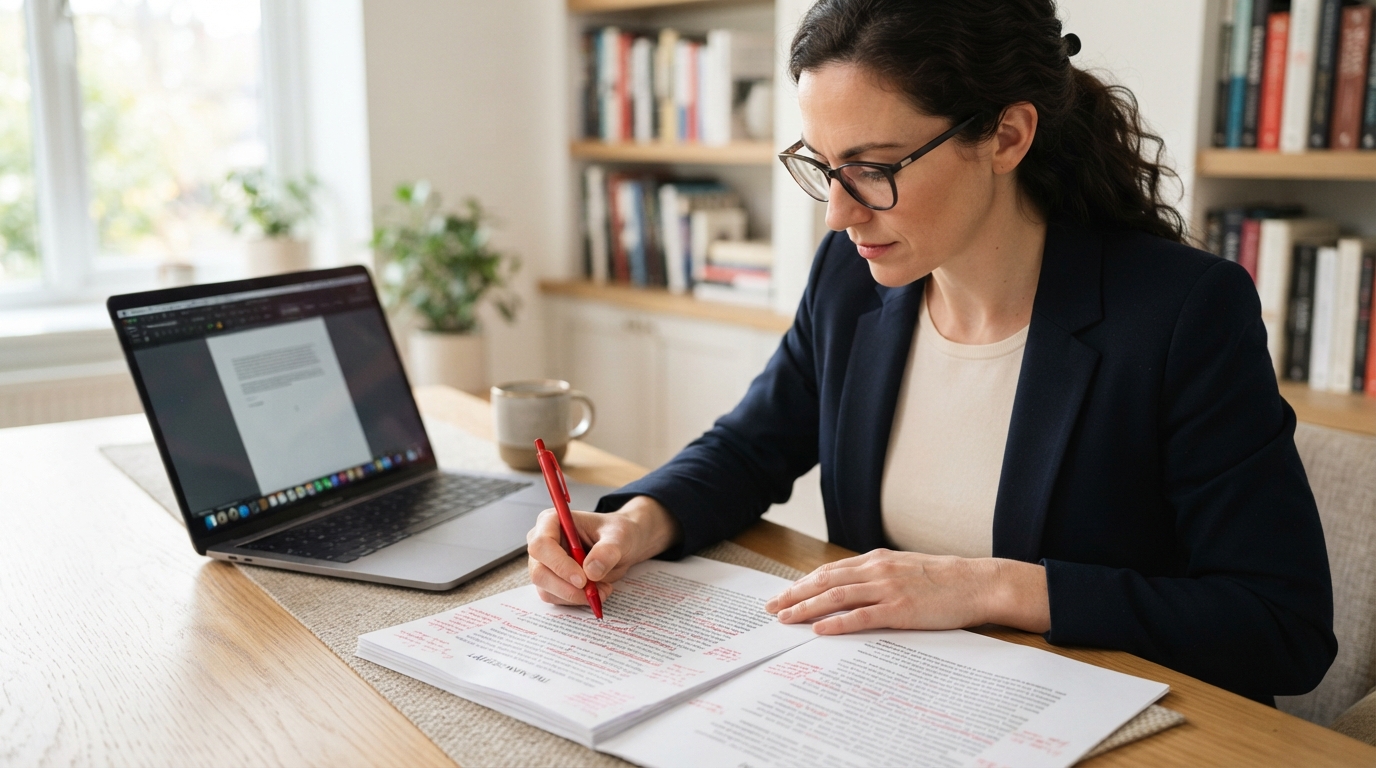
The primary objective of proofreading is quality control. A proofreader does not look at the big picture; they look at the microscopic details. They compare the final proof against the edited manuscript to ensure no errors were introduced during formatting, while also catching any lingering mistakes that slipped past previous editorial rounds.
| Editorial Stage | Primary Focus | Key Tasks | Does It Fix Grammar? |
|---|---|---|---|
| Developmental Editing | Structure, plot, pacing, character development, and overall flow. | Reorganizing chapters, deleting scenes, rewriting sections. | No, not primarily. |
| Line Editing | Style, tone, voice, sentence flow, and readability. | Tightening sentences, eliminating jargon, enhancing vocabulary. | Yes, indirectly through stylistic adjustments. |
| Copyediting | Technical accuracy, consistency, and style guide adherence. | Correcting grammar, spelling, punctuation, and internal facts. | Yes, comprehensively. |
| Proofreading | Final quality check, mechanical accuracy, formatting errors. | Fixing typos, punctuation slips, layout issues, and missed grammar errors. | Yes, as a final safety net. |
Grammar Mistakes a Proofreader Will Fix
When a proofreader reviews your manuscript, they are scanning for mechanical deviations from standard English rules (or the rules of your chosen style guide, such as Chicago Manual of Style, AP, or AMA). Here are the specific grammatical errors a proofreader will identify and resolve:
1. Subject-Verb Agreement Errors
A singular subject requires a singular verb, and a plural subject requires a plural verb. While this sounds simple, complex sentences often obscure these relationships. A proofreader will catch errors like:
- Incorrect: The group of academic researchers were planning a new study.
- Correct: The group of academic researchers was planning a new study.
2. Pronoun-Antecedent Disagreements
Pronouns must agree in number and gender with the nouns they replace. In modern publishing, navigating singular “they” vs. traditional gendered pronouns requires precision. A proofreader ensures consistency throughout the text.
- Incorrect: Every writer must submit their draft by Friday. (Traditional/Formal style guides may flag this, though modern usage is evolving. A proofreader ensures compliance with your specific style guide).
- Correct: All writers must submit their drafts by Friday.
3. Misplaced and Dangling Modifiers
Modifiers are words or phrases that describe something. If they are placed incorrectly, they can alter the meaning of a sentence in hilarious or confusing ways. Proofreaders excel at spotting these structural traps:
- Incorrect: Walking down the street, the library appeared on the left. (This implies the library was walking).
- Correct: As I was walking down the street, the library appeared on the left.
4. Tense Inconsistency
Writers often accidentally slip between past and present tenses, especially during long narrative arcs. A proofreader tracks the temporal consistency of your prose, ensuring that if you start in the past tense, you remain there unless a shift is logically warranted.
5. Run-on Sentences and Comma Splices
Joining two independent clauses with just a comma is one of the most common grammatical mistakes. A proofreader will correct these by adding coordinating conjunctions, semicolons, or breaking them into separate sentences.
- Incorrect: She loved to write fantasy novels, she spent every weekend outlining her world.
- Correct: She loved to write fantasy novels; she spent every weekend outlining her world.
If you want to ensure your book is entirely free of these errors before sending it to agents or self-publishing platforms, investing in professional Book Proofreading is highly recommended to secure your literary credibility.
What a Proofreader Will NOT Fix
It is equally important to understand what falls outside a proofreader’s jurisdiction. Expecting a proofreader to solve structural issues will lead to disappointment and an unfinished manuscript.
- Plot Holes and Character Arcs: If your protagonist changes eye color in Chapter 4 or travels faster than the speed of sound without explanation, a proofreader might flag it as a query, but they will not rewrite the scene to fix it.
- Voice and Tone Refinement: If your dialogue sounds stiff or your academic paper lacks a persuasive tone, a proofreader will not modify your vocabulary or sentence structure to make it sound better. That is the job of a line editor.
- Substantive Rewriting: A proofreader works with the words on the page. They will not delete paragraphs, move chapters around, or write new transitions.
“A proofreader is a protector of your voice, not a creator of it. They polish the glass so your readers can see your story clearly, without the distraction of smudges and dust.”
How Do Proofreaders Approach Grammar?
Professional proofreaders do not rely solely on their intuition; they utilize a systematic, highly structured approach to ensure absolute accuracy. Their toolkit includes:
- Style Sheets: A document detailing spelling preferences (e.g., US vs. UK English), capitalization rules, character names, and formatting choices specific to your manuscript.
- Style Guides: Industry-standard manuals such as the Chicago Manual of Style (CMOS) for fiction and nonfiction books, or the Associated Press (AP) Stylebook for journalism.
- Dictionaries: Typically the Merriam-Webster Collegiate Dictionary for US English or the Oxford English Dictionary for UK English.
During the process, proofreaders look for mechanical consistency. If you spell “cooperate” with a hyphen (“co-operate”) in Chapter 1, they ensure it is spelled the same way in Chapter 10.
Real-Time Google Search Queries: What Writers Ask About Proofreading
To help clarify common points of confusion, we have compiled the most frequent search queries regarding proofreading and provided direct, actionable answers.
| User Search Query | Direct Answer / Actionable Advice |
|---|---|
| “Can a proofreader rewrite my sentences?” | No. Proofreaders only correct errors. If a sentence is grammatically correct but poorly phrased, they may flag it with a comment, but they will not rewrite it. For rewriting, seek copyediting or line editing. |
| “Do proofreaders check for plagiarism?” | Generally, no. Plagiarism checking requires specialized software and is typically handled during the research or developmental editing phase. However, some proofreaders may offer this as an add-on service. |
| “Can I use Grammarly instead of a human proofreader?” | AI tools are helpful for initial drafts, but they lack contextual understanding. They miss homophones, nuances, and stylistic choices that a human proofreader easily catches. AI should supplement, not replace, human eyes. |
| “How much does professional proofreading cost?” | Rates typically range from $0.013 to $0.03 per word, depending on the complexity of the text, the timeline, and the experience level of the professional. |
Why Human Proofreaders Outperform AI and Automated Tools
In an era dominated by AI writing assistants, many writers wonder if hiring a human proofreader is still necessary. While software can catch basic spelling mistakes, it struggles with the nuances of human language.
- Homophones and Context: An automated tool might not flag “their” instead of “there” if both fit the basic syntax of a broken sentence structure, whereas a human instantly understands the intended meaning.
- Creative License and Dialogue: In fiction, characters often speak with poor grammar, slang, or regional dialects. AI tools will flag these as errors and suggest “corrections” that ruin the character’s voice. A human proofreader understands creative intent and preserves it.
- Formatting and Layout: Proofreaders check page numbers, headers, footers, table of contents alignment, and image captions—tasks that standard grammar software cannot perform.
Integrating Proofreading into the Self-Publishing Process
If you are preparing to publish independently, understanding where proofreading fits is vital to your financial and critical success. Before you submit your book to self-publishing services, you must ensure it has undergone thorough editing and final proofreading.
Once your manuscript is clean, you can confidently move forward with layout design and ebook publishing services. Skipping the proofreading step often results in negative reader reviews, which can permanently damage your book’s visibility and sales algorithm ranking.
A Quick Checklist for Writers Before Sending a Draft to a Proofreader
To get the most value out of your proofreading investment, complete these steps before handing over your manuscript:
- Run a basic spell-check: Eliminate the obvious typos yourself so your proofreader can focus on deep-level grammatical inconsistencies.
- Define your style preferences: Let the proofreader know if you are targeting a US or UK audience, and which style guide you prefer.
- Create a character/location list: Provide a list of unusual names, invented languages, or fantasy locations to prevent the proofreader from flagging them as spelling errors.
- Resolve major structural issues: Ensure you are completely finished with content changes. Making structural edits after proofreading introduces new errors and wastes your budget.
The Verdict: Do You Need a Proofreader?
If your goal is to publish a clean, professional, and credible piece of work, then yes—you absolutely need a proofreader. They are the final gatekeepers of grammatical integrity. By identifying and fixing lingering grammar mistakes, punctuation slips, and formatting inconsistencies, a proofreader ensures that your ideas are communicated clearly and that your authority as an author remains unquestioned.