
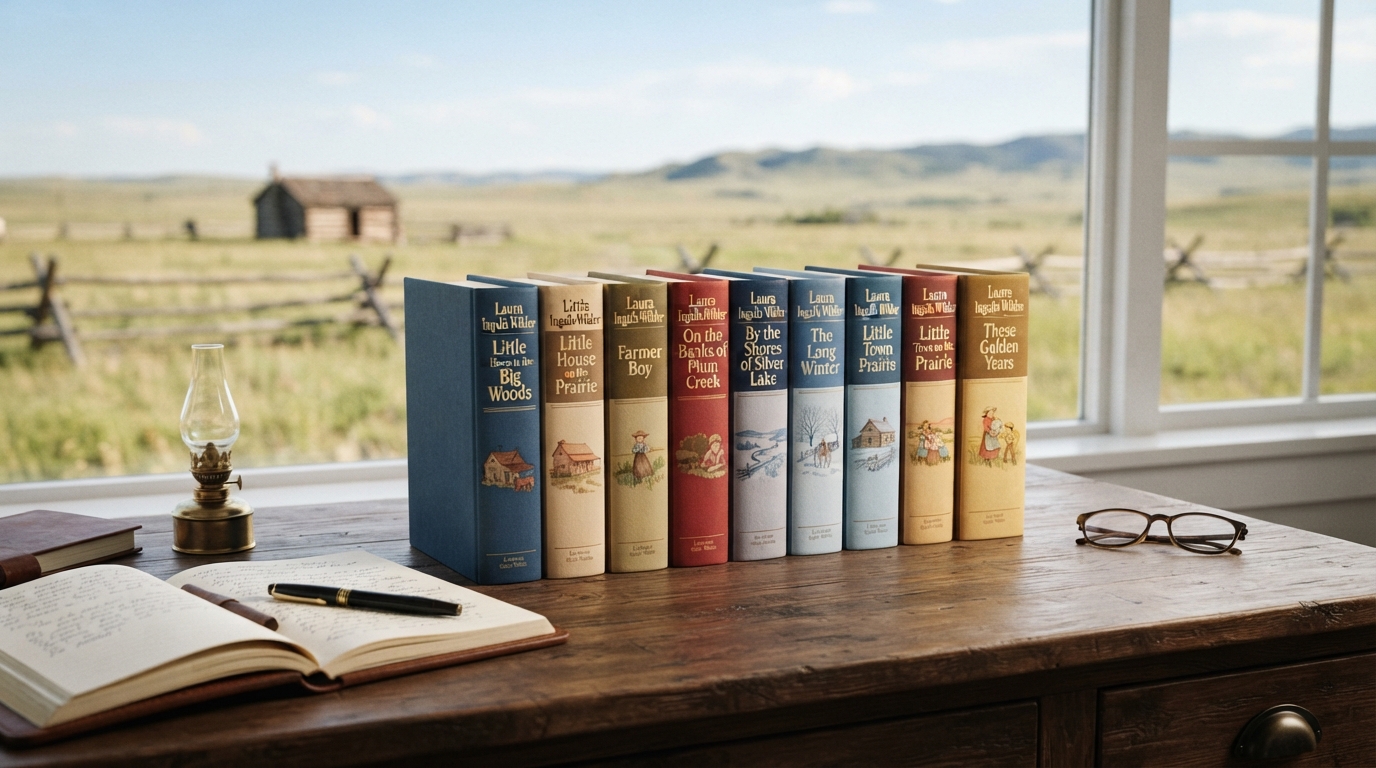
The Definitive Little House on the Prairie Reading Order
The recommended reading order for Laura Ingalls Wilder’s classic series is the chronological reading order, which traces the linear progression of Laura’s life alongside her family’s journey across the American frontier. This sequence begins with Little House in the Big Woods, followed by Farmer Boy (introducing her future husband, Almanzo), Little House on the Prairie, On the Banks of Plum Creek, By the Shores of Silver Lake, The Long Winter, Little Town on the Prairie, These Happy Golden Years, and concludes with the posthumously published The First Four Years. Following this path allows readers to experience the historical development of the American West and Laura’s coming-of-age story in the exact sequence the events occurred.
For decades, the autobiographical fiction of Laura Ingalls Wilder has captured the imagination of readers worldwide. Chronicling the struggles, triumphs, and daily realities of 19th-century pioneer life, these books are more than just children’s literature; they are a vital historical record of the American frontier. Whether you are a first-time reader, a parent introducing these classics to your children, or an educator analyzing Western expansion, understanding the optimal reading order and the thematic depth of each volume is essential.
In this comprehensive guide, we will break down both the chronological and publication orders, provide in-depth summaries of each book, analyze the historical context, and explore the fascinating collaborative writing process behind these masterpieces.
—
Chronological vs. Publication Order: How to Read the Series
While most readers prefer the chronological timeline because it follows Laura’s growth from a four-year-old girl in Wisconsin to a young pioneer wife in South Dakota, the publication order offers a slightly different perspective. The primary difference lies in where you place Farmer Boy, which focuses entirely on the childhood of Almanzo Wilder in upstate New York, and The First Four Years, which was discovered after Laura’s death and published in its raw, unedited form.
To help you decide which path to take, here is a comparative overview of both reading sequences:
| Chronological Order (Recommended) | Publication Order | Setting / Location | Laura’s Age (Approx.) |
|---|---|---|---|
| 1. Little House in the Big Woods (1932) | 1. Little House in the Big Woods (1932) | Pepin, Wisconsin | 4–5 years old |
| 2. Farmer Boy (1933) | 2. Farmer Boy (1933) | Malone, New York | N/A (Focuses on Almanzo, age 8-9) |
| 3. Little House on the Prairie (1935) | 3. Little House on the Prairie (1935) | Independence, Kansas | 6–7 years old |
| 4. On the Banks of Plum Creek (1937) | 4. On the Banks of Plum Creek (1937) | Walnut Grove, Minnesota | 7–9 years old |
| 5. By the Shores of Silver Lake (1939) | 5. By the Shores of Silver Lake (1939) | De Smet, South Dakota | 12–13 years old |
| 6. The Long Winter (1940) | 6. The Long Winter (1940) | De Smet, South Dakota | 13–14 years old |
| 7. Little Town on the Prairie (1941) | 7. Little Town on the Prairie (1941) | De Smet, South Dakota | 14–15 years old |
| 8. These Happy Golden Years (1943) | 8. These Happy Golden Years (1943) | De Smet, South Dakota | 15–18 years old |
| 9. The First Four Years (1971) | 9. The First Four Years (1971) | De Smet, South Dakota | 18–22 years old |
—
Comprehensive Summaries of Each Book in Chronological Order
1. Little House in the Big Woods (1932)
The journey begins in 1871 in a cozy log cabin nestled deep within the Big Woods of Pepin, Wisconsin. Here, we meet four-year-old Laura, her older sister Mary, her baby sister Carrie, and their devoted parents, Charles (Pa) and Caroline (Ma) Ingalls. This book establishes the foundational themes of the series: family solidarity, self-reliance, and the comforting security of home amidst a vast, untamed wilderness.
Unlike later books that feature constant travel and geographic displacement, Little House in the Big Woods is deeply rooted in place. It focuses on the cyclical nature of pioneer life through the seasons. Readers learn about the meticulous preparation required to survive the harsh Wisconsin winters, including smoking venison, harvesting maple sugar in the spring, and storing crops. Pa’s fiddle-playing serves as a recurring motif of warmth, safety, and cultural preservation in the wild.
2. Farmer Boy (1933)
Though written second, Farmer Boy steps away from the Ingalls family to introduce Almanzo Wilder, the boy who would eventually become Laura’s husband. Set on a prosperous, established farm in Malone, New York, this novel offers a stark contrast to the hand-to-mouth, migratory existence of the Ingalls family. The Wilders enjoy material abundance, structured schooling, and a highly organized agricultural operation.
The narrative follows young Almanzo as he strives to prove he is responsible enough to handle his father’s prized horses. Through mouth-watering descriptions of Ma Wilder’s cooking and detailed accounts of sheep shearing, harvesting, and county fairs, the book celebrates the rewards of hard work, discipline, and traditional American agrarian values. Reading this book second provides vital context for Almanzo’s character before he enters Laura’s life in South Dakota.
3. Little House on the Prairie (1935)
In this pivotal and famous volume, Pa Ingalls decides that the Big Woods of Wisconsin have become too crowded. Packing their belongings into a covered wagon, the family travels southwest to the Indian Territory of Kansas, settling near Independence. This book is the quintessential American pioneer story, depicting the physical construction of a home from scratch, the digging of a well, and encounters with wild animals.
However, the novel also introduces the complex, often tense realities of historical Western expansion. The Ingalls family builds their cabin on land reserved for the Osage Nation, leading to constant underlying anxiety. The book culminates in a heartbreaking decision: when the government dispatches troops to evict white settlers who have crossed into Indian Territory, Pa chooses to pack up and move again rather than wait to be forced out, highlighting the volatile nature of frontier homesteading.
4. On the Banks of Plum Creek (1937)
The Ingalls family relocates to Walnut Grove, Minnesota, settling along the fertile banks of Plum Creek. Hoping to establish a permanent, prosperous farm, Pa builds a beautiful new house made of sawed lumber, using credit secured against his future wheat crop. Here, Laura and Mary attend school for the first time, experience church community life, and encounter town dynamics, including their famous rivalry with the spoiled Nellie Oleson.
The family’s dreams of financial stability are shattered by a devastating plague of grasshoppers (locusts) that destroys the entire wheat crop in a matter of hours. This disaster forces Pa to walk hundreds of miles eastward to find work to pay off his debts. The book highlights the extreme vulnerability of pioneer farmers to the whims of nature and the resilient spirit required to survive repeated economic ruin.
5. By the Shores of Silver Lake (1939)
Marking a transition into Laura’s adolescence, this book begins with hardship: the family has survived scarlet fever, which left Laura’s beloved older sister Mary permanently blind. Needing a fresh start and financial relief, Pa accepts a job as a storekeeper and payroll clerk for the Chicago and North Western Railway in the Dakota Territory. The family moves to the active railroad camp that would eventually become the town of De Smet, South Dakota.
As the “railroad town” develops, Laura experiences the rapid transition from wild prairie to structured civilization. She takes on greater responsibility within the family, acting as “Mary’s eyes” by describing the world around them in vivid detail. By the end of the book, Pa files a claim on a homestead, securing the land that would become their permanent home.
6. The Long Winter (1940)
Widely regarded by literary critics as Laura Ingalls Wilder’s narrative masterpiece, The Long Winter is a gripping account of survival against near-impossible odds. Anticipating a brutal winter based on an Indian warning, the Ingalls family moves from their exposed claim shanty into Pa’s building in the town of De Smet. The prediction proves terrifyingly accurate: a series of relentless blizzards cuts off the railroad, leaving the town isolated from October until April.
As coal and flour supplies run out, the family faces freezing temperatures and starvation. They survive by grinding seed wheat in a hand-cranked coffee mill and twisting slough grass into tight logs for fuel. The climax of the book features young Almanzo Wilder and Cap Garland risking their lives to travel across the frozen prairie to find a rumored cache of wheat, saving the town from starvation.
7. Little Town on the Prairie (1941)
With the survival of the long winter behind them, life in De Smet begins to flourish. This volume focuses on the social and educational growth of the town and of Laura herself. Now a teenager, Laura works hard in school with the goal of earning her teaching certificate so she can help pay for Mary to attend the College for the Blind in Vinton, Iowa.
The book introduces more mature themes, including Laura’s first job sewing shirts in town, her participation in local socials and literary societies, and the sweet beginnings of her courtship with Almanzo Wilder. The narrative ends on a triumphant note when fifteen-year-old Laura passes her examinations and receives her certificate to teach school.
8. These Happy Golden Years (1943)
This book chronicles Laura’s transition from girlhood to womanhood. It begins with her first teaching assignment at the Brewster settlement, twelve miles from home. Living in a tense, unhappy household and teaching in a drafty shanty, Laura battles homesickness and difficult conditions. Almanzo Wilder supports her by driving his sleigh through freezing temperatures every weekend to bring her home to her family.
The courtship blossoms over three years of buggy rides and shared dreams. After Mary successfully begins her education at the college for the blind and Laura completes several teaching terms, she and Almanzo are married in a simple ceremony. The book concludes with the young couple moving into their own little home on Almanzo’s tree claim, filled with hope for the future.
9. The First Four Years (1971)
Published nearly fifteen years after Laura’s death, this final volume offers a raw, unembellished look at the early years of Laura and Almanzo’s marriage. Unlike the previous books, which were heavily edited for a younger audience, this manuscript was found among Wilder’s papers and published almost exactly as she wrote it. It covers their struggle to establish their farm, the birth of their daughter Rose, the tragic death of their unnamed infant son, a devastating house fire, and the debilitating effects of diphtheria on both Laura and Almanzo.
While significantly darker and less romanticized than the preceding books, The First Four Years is a deeply honest portrayal of the immense difficulties faced by young homesteaders. It serves as a realistic epilogue to a legendary saga, showing that despite overwhelming adversity, their love and resilience remained unshaken.
—
Historical Context and Themes of the Frontier
To fully appreciate the Little House series, readers must understand the historical forces that shaped Laura’s life. The books span a period of intense rapid development in American history, characterized by the Homestead Act of 1862, the rapid expansion of the transcontinental railroads, and the displacement of Native American populations.
- The Homestead Act: Pa Ingalls’ constant search for land was driven by the promise of 160 free acres of public land, provided the settler built a dwelling, cultivated the land, and lived there for five years. This law fueled the westward migration of hundreds of thousands of families.
- The Railroad Boom:By the Shores of Silver Lake shows how the iron horse transformed the West overnight. The railroad brought vital goods, mail, and new settlers, but it also made communities entirely dependent on train schedules—a vulnerability highlighted in The Long Winter.
- The Pioneer Work Ethic: Every book in the series emphasizes self-reliance. From making their own door latches to preserving wild plums, the Ingalls family demonstrates a level of resourcefulness that has become a cornerstone of American cultural identity.
—
The Literary Partnership: Laura Ingalls Wilder and Rose Wilder Lane
One of the most fascinating aspects of the Little House books is their unique path to publication. Laura Ingalls Wilder did not begin writing her memoirs until she was in her sixties, prompted by the stock market crash of 1929 and the death of her parents and sister. Her initial draft, an adult memoir titled Pioneer Girl, was rejected by multiple publishers.
Undeterred, Laura collaborated with her daughter, Rose Wilder Lane, an accomplished journalist and novelist. Rose helped her mother restructure the raw biographical material into a narrative arc suitable for children, focusing on a single character named “Laura” and simplifying complex historical sequences. This collaborative dynamic has been the subject of extensive literary research, showcasing how professional editorial guidance can transform raw personal history into timeless art.
If you are looking to bring your own family history or biographical stories to life with the same narrative grace, professional Ghostwriting Services can help structure your memoirs. Working with a trusted partner like Collins Ghostwriting ensures that your unique personal legacy is preserved with high literary quality, capturing the emotional truth of your experiences just as Laura and Rose did for the Ingalls family legacy.
—
Real-Time Search Queries & Frequently Asked Questions
Is “Farmer Boy” necessary to read?
Yes, while it does not feature Laura, it is essential for understanding the background of her future husband, Almanzo Wilder. Reading it in chronological order (as Book 2) provides a wonderful contrast between the established farming communities of the East and the rugged pioneering of the West.
Why is “The First Four Years” so different from the other books?
Unlike the first eight books, which were thoroughly revised and polished by Laura and her daughter Rose Wilder Lane for young readers, The First Four Years was published posthumously from Laura’s draft. It contains a more mature, realistic, and sometimes somber tone, reflecting the hard realities of early marriage and farming life.
Where did the Ingalls family actually live?
The family was highly mobile. Their real-life journey took them to Pepin, Wisconsin; Independence, Kansas; Walnut Grove, Minnesota; Burr Oak, Iowa (an era omitted from the books); and finally, De Smet, South Dakota, where Ma and Pa lived out the remainder of their lives.
What is the correct age group for the Little House books?
The series is uniquely structured to grow with the reader. Little House in the Big Woods is written with simpler language and sentence structures suitable for children aged 7–9. As the series progresses and Laura grows, the vocabulary, themes, and emotional complexity mature, making the final books perfect for young adults and adult readers alike.